
Over-the-Counter Hearing Aids in British Columbia
As of 17 June 2026, adults 18 and older in British Columbia can buy Health Canada–licensed over-the-counter (OTC) hearing aids without a prescription and without a hearing test.
British Columbia was the first province in Canada to allow it. This guide explains what changed, who OTC hearing aids suit, how you set them up yourself, and how to buy from a licensed B.C. hearing professional.
By Jamie Larsen, RHIP — Registered Hearing Instrument Practitioner (B.C.) · Published: 2026-Aug-16
Quick Facts
Legal in B.C. since June 17, 2026 – British Columbia was the first province in Canada to allow OTC hearing-aid sales.
For adults 18 and older – OTC hearing aids are intended for self-perceived mild-to-moderate hearing loss.
No hearing test or prescription required – You can purchase and set them up yourself.
You control your own settings – Use an in-app hearing check or your existing audiogram, then adjust them yourself.
Nearly half of Canadian adults aged 60–79 have at least mild hearing loss, and about 70% of people with measured hearing loss have never been diagnosed (Statistics Canada). Addressing hearing changes while they’re still mild is usually the easier path, and OTC hearing aids give you a simple, lower-cost way to do it on your own terms.
What changed in June 2026?
On 17 June 2026, the B.C. government made it legal to sell Health Canada–approved over-the-counter hearing aids — at retail and online — to adults 18 and older with mild-to-moderate hearing loss, with no prescription or hearing test needed to buy. British Columbia is the first province in Canada to do this.
Before the change, buying a hearing aid in B.C. generally meant going through a clinic. For a lot of people with mild-to-moderate hearing difficulty, that felt like a big step for what they saw as a small problem. The June 2026 change opens a direct, lower-cost path: you can buy a licensed hearing aid yourself and manage it on your own.
To be clear: you don’t have to see a hearing professional to buy or use these. You can buy an OTC hearing aid, set it up yourself, and manage it entirely on your own — you’re in control. Hearing professionals still diagnose, fit and provide clinical care for anyone who wants it, and we’re glad to help if you’d like a hand — but with OTC, that’s your choice, not a requirement.
Takeaway: OTC hearing aids are legal in B.C. for adults 18+ with mild-to-moderate hearing loss. No test or prescription is needed to buy.
“Too often, people put off getting help for hearing loss because it can be difficult or expensive to access support.”
— Josie Osborne
B.C. Minister of Health
“More affordable, non-prescription options will help support dignity, independence and healthy aging.”
— Dan Levitt
B.C.’s Seniors Advocate
“Expanding access to over-the-counter hearing aids is a positive step toward helping more British Columbians explore support sooner.”
— Heather Ritchie
President, Speech and Hearing BC
Read More: When to see a hearing professional →
Are these real hearing aids? Health Canada licensing
Yes. A hearing aid is a Class II medical device that Health Canada licenses. The Warbler Series 7 we carry holds Health Canada Medical Device Licence #111379. That’s different from a “personal sound amplifier” (PSAP), which only makes sounds louder, is not a medical device, and is not licensed.
The difference matters. A licensed hearing aid is designed and authorized to help with hearing loss; a cheap amplifier from a marketplace listing is not. When you see a Medical Device Licence number, you can look it up in Health Canada’s public database.
There’s a practical bonus, too: because it’s a licensed hearing aid, you don’t pay sales tax on it. Hearing aids are zero-rated for GST/HST across Canada and exempt from B.C. provincial sales tax — so the price of the device is the price you pay, with no tax added at checkout.
| Amplifier (PSAP) | OTC hearing aid | Prescription hearing aid | |
|---|---|---|---|
| What it is | A gadget that makes sound louder | Health Canada–licensed medical device | Health Canada–licensed medical device |
| Health Canada licensed | No | Yes (Series 7 = MDL #111379) | Yes |
| Who it’s for | General use | Adults 18+, mild-to-moderate | Any degree, incl. severe/complex |
| Set-up | You | You (self-fit) | Professionally fitted |
| Sales tax (B.C.) | Taxable | None (zero-rated + PST-exempt) | None |
| Relative cost | Low | Lower | Highest |
Takeaway: A licensed hearing aid is a regulated medical device (and tax-free) — an amplifier is neither.
A quick test you can use on any seller: ask for the Health Canada Medical Device Licence number. A real hearing aid has one, and the seller can give it to you in a sentence (ours is MDL #111379). If the answer is vague, or it’s an FDA number, or a “certificate” from somewhere unnamed — that’s your answer.
One more category to know about: consumer earbuds with a hearing feature. They sit in between and are changing fast — some are genuinely useful for mild loss, but not all are licensed as hearing aids in Canada, and that status changes. Check before you assume.
Read more: Hearing aids vs amplifiers →
Who are OTC hearing aids for?
OTC hearing aids suit independent adults (18+) with self-perceived mild-to-moderate hearing loss who want help in specific situations and are comfortable using a smartphone app to set up and adjust their own devices.
That often sounds like: “I hear fine most of the time, but I struggle in restaurants.” “I miss parts of conversations in meetings.” “My family says the TV is too loud.” “I’m not ready to spend thousands or keep going back to a clinic.” If that’s you, and you can insert, charge, clean and manage a small device with an app, OTC hearing aids are worth considering.
This is about capability, not age. Plenty of older adults manage their own devices with ease, and some younger adults would rather have professional support. What matters is whether you’re comfortable setting up and looking after the hearing aids yourself.
Who OTC hearing aids may not be right for
OTC hearing aids are designed for adults with mild-to-moderate hearing loss who are comfortable setting up and managing their own devices. They may not be the best choice if:
- Your hearing loss seems more than mild-to-moderate
- You have complex hearing needs or significant difficulty understanding speech
- You want a professional to test your hearing, fit and program your hearing aids
- You’re not comfortable using an app or adjusting the devices yourself
- You have difficulty inserting, charging, cleaning or maintaining small devices
- You want ongoing clinical follow-up rather than primarily self-managed hearing care
- You’re under 18. B.C.’s OTC pathway is for adults 18 and older.
If none of these apply and your hearing difficulty feels mild-to-moderate, OTC hearing aids may be a good fit. If you’re unsure, that’s exactly what our optional ear-health check is for.
Medical red flags: when to see a doctor first
Some hearing and ear symptoms need medical assessment before you consider any hearing aid, OTC or prescription.
⚠ Sudden or rapidly worsening hearing loss? Seek emergency medical attention.
A rapid change in hearing over hours or a few days should be assessed urgently.
- Hearing loss in one ear only
- Ear pain, discomfort, drainage, or bleeding
- Persistent or one-sided ringing (tinnitus)
- Dizziness or balance problems
- Suspected earwax, or something stuck in the ear
Do you need a hearing test for OTC hearing aids?
No — you don’t need a hearing test or a prescription to buy OTC hearing aids in B.C. A test can still help, because it confirms your loss is mild-to-moderate and rules out a medical cause. But it isn’t required.
One important distinction: an in-app hearing test is not a diagnostic assessment. It is a self-check performed in an uncontrolled setting — a reasonable way to set up a device, but it cannot identify why hearing loss is present (conductive vs sensorineural, or a medically significant difference between the ears). Where a diagnostic audiogram is available, it is the better input — enter it instead.
App hearing test vs your audiogram →
How do you set them up? You self-fit
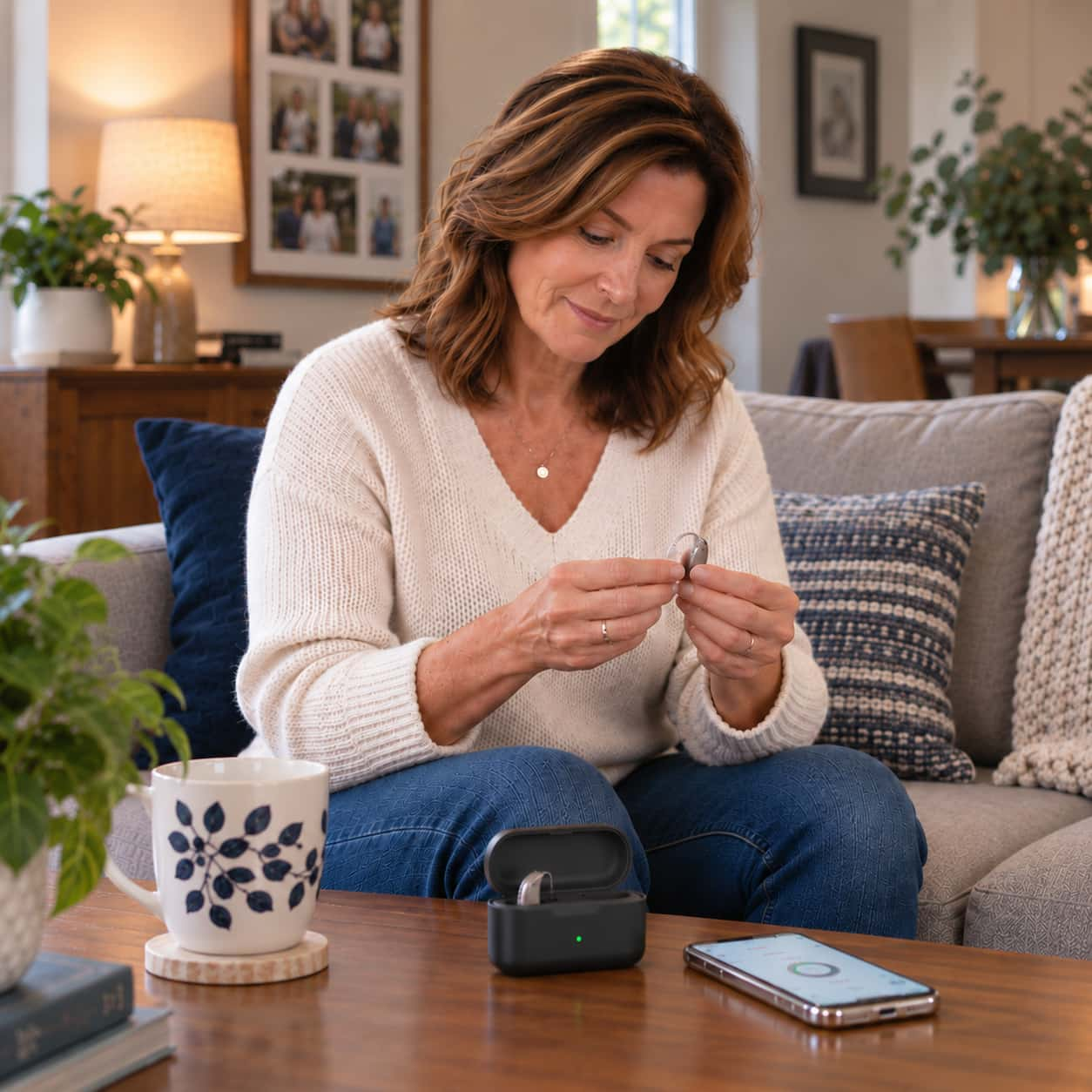
You set up the hearing aids yourself, in one of two ways: take the hearing check inside the Warbler app, or enter your own existing audiogram. The app adjusts the hearing aids to your results, and you can fine-tune the sound to your own preference, any time.
Here’s the part that’s different from a traditional clinic: we show you how to set them up — we don’t program them for you. With most prescription hearing aids, a clinician locks in the settings and you can’t change much beyond the volume. These are the opposite: they stay open for you to adjust to your own hearing levels and sound preferences, whenever you like — you’re never locked out of your own devices. If you already have an audiogram from a previous hearing test, you can enter those numbers yourself; if you don’t, the app can check your hearing and set a starting point. Either way, it’s your device to manage.
Takeaway: You’re in control — you set up and adjust your own hearing aids, and you’re never locked out.
Optional local onboarding and ear-health check
If you’d like a hand getting started, you can book an optional in-person onboarding session. We help you with fit, insertion, cleaning, charging, connecting the app, and entering your own settings — and we do a quick otoscopy (a look in your ears to check ear health).
To be clear about what this is and isn’t: it’s setup help plus an ear-health check. It is not a diagnostic hearing test, not a diagnosis, and not programming your hearing aids for you. Most people won’t need it — the whole idea is that you can manage these yourself — but it’s there if you want a confident start.
Read more: Local onboarding & setup →
OTC vs. prescription hearing aids: what’s the difference?
OTC hearing aids are lower-cost, self-fitted devices for mild-to-moderate hearing loss and specific situations. Prescription hearing aids involve a diagnostic test, professional fitting and verification, and ongoing clinical care — a better path for more complex or more severe hearing loss.
Neither is “better” in the abstract; they suit different people. Some people are well served by a self-managed OTC device and the option of local help. Others genuinely need diagnostic testing, professional fitting, real-ear verification and ongoing care — and for them, a clinic is the right choice. If your needs change over time, there’s always a path to more support.
Read more: OTC vs prescription hearing aids →
Where can you buy OTC hearing aids in B.C.?
Now that they’re legal, you can buy OTC hearing aids in B.C. from retail stores, pharmacies and online sellers. That convenience is the point of the change — but most of those options leave you to sort everything out on your own.
Buying through Vancouver Custom Earplugs gives you the same OTC price and self-managed control, but you’re not left completely on your own. You’re buying from a licensed B.C. Hearing Instrument Practitioner who has fitted hearing aids for over a decade — with optional in-person onboarding and an ear-health pre-check if you want a confident start. Use that experience as much or as little as you like.
Read more: Compare self-managed and locally supported options →
Buying from a licensed B.C. professional
Vancouver Custom Earplugs is run by a licensed B.C. Registered Hearing Instrument Practitioner. We sell OTC hearing aids to British Columbia residents, with clear setup resources, reasonable email support, optional in-person onboarding, and 45-day returns handled through our office — so you get professional credibility without signing up for a full clinic program.
There is a fair case for buying from a licensed practice rather than a marketplace. An OTC hearing aid from a large online retailer may work out fine, but it comes with no one in the province who is professionally accountable for the advice. Vancouver Custom Earplugs is operated by a licensed B.C. Hearing Instrument Practitioner: if a device is not suited to a customer’s hearing, that is identified before purchase, not after the return window closes.
A few practical points:
- Available to B.C. residents. We ship within British Columbia.
- You’re in control. You self-fit and adjust your hearing aids; we’re here to show you how.
- Returns are local and simple. Within 45 days, drop your device off at our office or ship it back to us.
- Support is clear and bounded. Setup resources and reasonable email help are included; extra hands-on help is available if you want it.
What’s not included
Stated plainly: the purchase does not include ongoing appointments, unlimited adjustments, free cleaning visits, diagnostic hearing testing, or continuing hearing-aid care — these are the services a full clinic package (several thousand dollars) provides. Additional help can be booked separately at any time. If it becomes clear that a customer’s hearing requires clinical care, Vancouver Custom Earplugs will say so and refer them to an appropriate provider.